
Stress and drug effects

Stress and painkillers: why when you’re given an opioid may matter
Opioid painkillers like oxycodone are often prescribed at some of the hardest moments in people’s lives — after surgery, after an accident, during serious illness. These are also moments of high stress.
We have long known that stress is linked to a higher risk of problematic opioid use. What we have not known is whether stress itself causes people to want more of the drug, or whether the two simply tend to occur together. Answering that requires an experiment, and until now that experiment had not been done in people.
Our project set out to do it. Sixty-six healthy volunteers came to the lab for four three-hour sessions. Before each session they went through either a stressful task or a calm comparison task. They then received a dose of oxycodone through a drip — or a dose of saline with no drug in it. Neither the participants, the staff in the room, nor the researchers analysing the data knew which was which.
Afterwards, participants could work for a second dose. They chose how strong they wanted it to be, and then had to earn it by pressing a key rapidly for two minutes. The closer they got to their target, the harder the task pushed back. On average they pressed around 667 times.
Finding 1 — Stress made men take more opioid. It did not have the same effect in women.
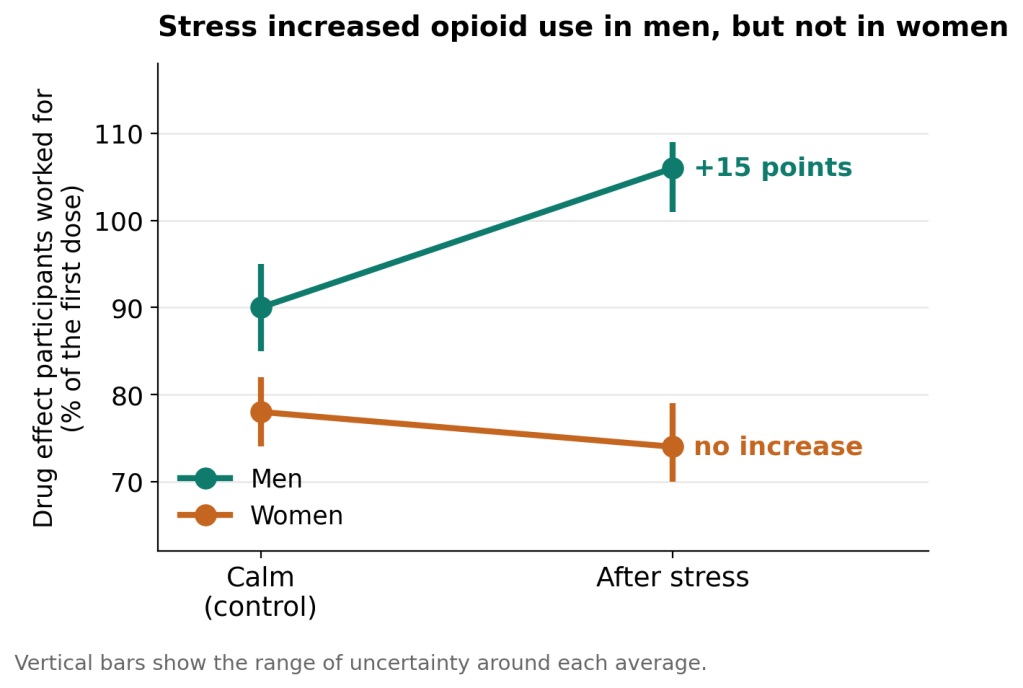
After the stressful task, men worked for a noticeably stronger second dose than they did when calm — about 15 percentage points more. Women showed no such increase.
The reason is not the obvious one. Oxycodone did not relieve stress in this study, in either men or women, and it did not lift people’s mood compared with placebo. So the men who took more were not medicating away a bad feeling.
Nor were they chasing a better high. In fact, men reported liking the drug less under stress than when calm — while still working for more of it. Wanting the drug and enjoying the drug came apart.
Why it matters: if stress can push opioid use up on its own — without the drug even making people feel better — then the circumstances in which a prescription is given may be part of the risk picture, alongside dose and duration. That is worth knowing for anyone prescribing after surgery or injury.
Finding 2 — A stress test that keeps working on repeat use
Studying stress in a laboratory has a practical problem: the standard methods really only work once. The second time someone faces the same ordeal, they know what is coming, and the stress response fades. That makes designs like ours — where everyone has to be stressed on more than one visit — very hard to run.
So we built a solution: the Repeatable Social Stress Test (ReSST). It has two parts.
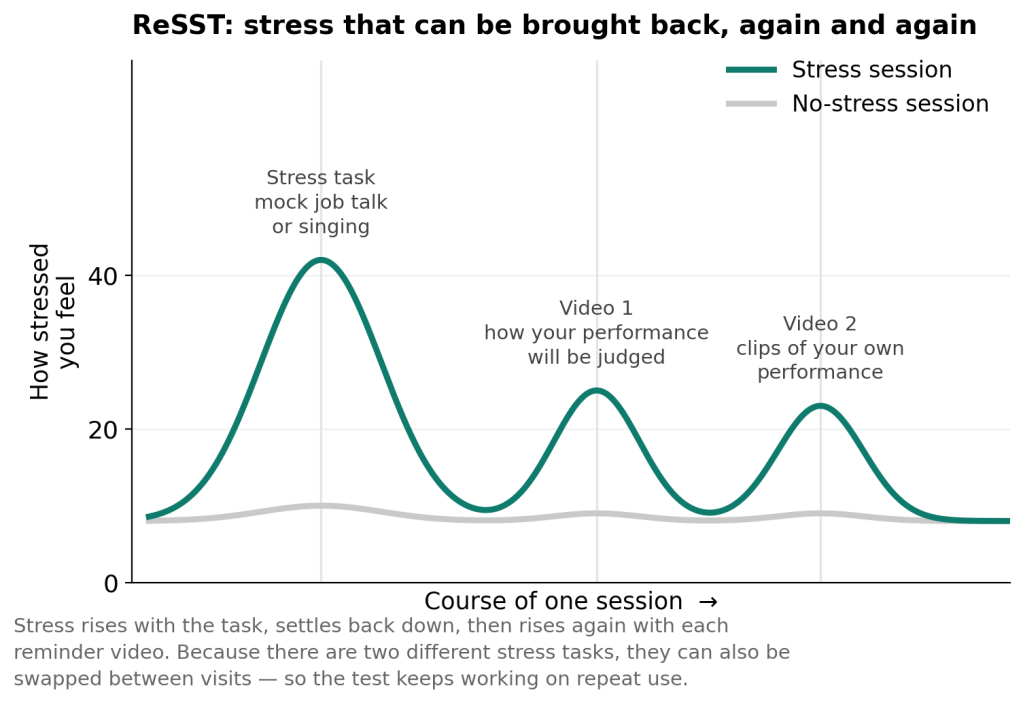
Two different stress tasks. Participants either give a mock job talk to a panel of evaluators, or sing in front of them. Both reliably make people feel stressed, raise their heart rate, and raise the stress hormone cortisol — and each has a carefully matched comparison task that is not stressful. Because there are two, you can swap between them across visits so that neither becomes familiar.
Two reminder videos. Stress from the task itself fades fairly quickly. So later in the session participants are shown a short video explaining how their performance will be judged, and later still, clips of their own performance. Each one brings the stress response back up before it settles again — so a single visit produces several stress peaks rather than just one.
We have made the full method — including the videos and materials — freely available so that other research groups can use it: osf.io/rq5wv
Finding 3 — Oxycodone and driving (work in progress)
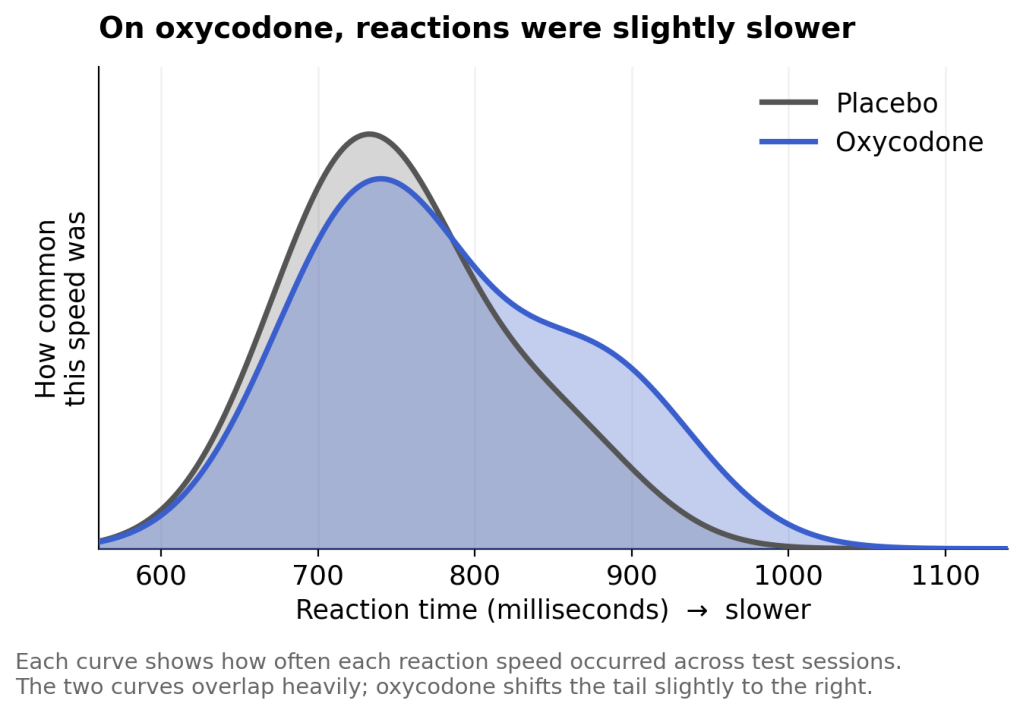
Many people take prescription opioids and still need to drive. So we tested how a single dose affected the kind of quick reactions driving depends on.
Reactions were slightly slower on oxycodone than on placebo — but the effect was modest, and the two curves overlap a great deal. Accuracy was largely unaffected. Notably, the amount of oxycodone measured in a person’s blood did not reliably predict how impaired they were. Two people with the same blood level could be affected quite differently.
Why it matters: this is relevant to how road-safety guidance is written. A blood concentration limit, of the kind used for alcohol, may not translate straightforwardly to prescription opioids.
These results are from a manuscript in preparation and should be treated as preliminary.
What this does and doesn’t tell us
Our volunteers were healthy adults aged 19–58 with little previous opioid exposure, and they chose to take part in a demanding four-session study. We compared them against 764 Norwegian surgical patients and found them broadly similar, so the findings are likely to be informative for a large group of patients who receive opioids after surgery. They tell us less about people already living with substance use problems or the aftermath of trauma.
The study was also not originally designed to compare men and women, so the sex difference — though large and statistically robust — should be confirmed in work built for that purpose.
More to come
The project is ongoing, with further findings on reward, decision-making and behaviour still to be published.
Publications
Eikemo M, Løseth GE, Carlyle M, Trøstheim M, Ernst G, Pazmandi C, Thompson M, Vezzani C, Meier IM, Roland MN, Johnstone T, Heilig M, Biele G, Leknes S. Effects of psychosocial stress on opioid self-administration in healthy participants: a randomized, placebo-controlled crossover trial. Nature Mental Health (2026). doi.org/10.1038/s44220-026-00700-x
Vezzani C, Martinussen L, Thompson M, et al. The Repeatable Social Stress Test (ReSST): a guide and validation of a novel paradigm to elicit repeatable stress responses in humans. PsyArXiv (2026). doi.org/10.31234/osf.io/s89xa_v2
Open data, code and materials: osf.io/3jvw8 · ReSST materials: osf.io/rq5wv
Funding: European Research Council (Horizon 2020, grant 802885) and the Swedish Research Council (grant 2013-07434).

