
SpectrO: Understanding opioids’ variable effects
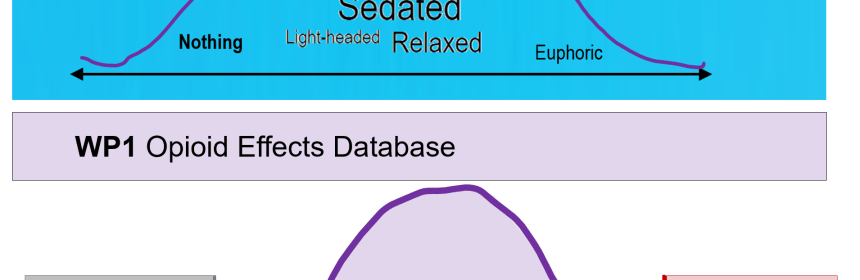

As illustrated by this word cloud generated by our surgery patients (see http://www.NorOp.net), opioids make people feel a lot of things. However, we currently lack the means to predict who will feel what: who will achieve good pain relief, who will vomit and who will be at risk of addiction. The dominating paradigm in the literature is the group-based RCT, which gives us the mean, but cannot be used to predict individual responses.
In SpectrO, we will start by pooling all of the data with full variance across all of the key effects into a database. Analysing across these rich interdisciplinary datasets will really allow us to understand individual variability and resolve controversies in the literature.
We will also hone in on a really interesting and recently discovered population of people whose mu-opioid receptors are silenced due to a mutation. The aim is to understand why opioids effects are so variable and diverse by understanding the receptor system that they target.
The third part of SpectrO will use a series of N-of-1 RCTs to adjust medication doses, turning clinical practice into science by applying double-blinded, randomised duration dose titration in opioid-treated chronic pain patients. The aim of work package is to reconcile the science with the clinic by showing, using gold standard methodology, that some patients really do benefit from opioids over time
 Affective Brain lab